
5 myths of geothermal heating and cooling, debunked
Is geothermal too expensive? Does it only work in certain climates? Do you need acres of land to install it? We're separating fact from fiction about one of the most promising technologies for building decarbonization.
As institutions seek ways to reduce carbon emissions, improve building performance, and manage rising operating costs, geothermal heating and cooling is becoming an increasingly attractive option. Yet despite its growing popularity, misconceptions about the technology still keep building owners from seriously considering it.
Geothermal heating and cooling (also known as ground-source or ground-coupled heat pump technology) uses the relatively stable temperatures beneath the Earth’s surface to transfer heat into and out of buildings. This process can provide highly efficient heating and cooling while reducing reliance on fossil fuels (read more about how heat pumps work here).
For institutions and communities managing aging infrastructure, geothermal can offer a pathway toward long-term decarbonization. But is it the right solution for your building?
Before ruling it out, let’s address five common myths about geothermal heating and cooling.
Myth #1: Geothermal Is Always the Most Expensive Option
The reality: Geothermal may cost more upfront, but it may offer the lowest total cost of ownership
over the system’s life.
One of the biggest misconceptions about geothermal is that its installation costs make it financially impractical. While drilling boreholes and installing underground piping can require a significant initial investment, geothermal projects are eligible for increased utility incentives as well as federal tax credits (more on those later) to reduce the upfront cost significantly — in some cases by upwards of 50% of the project cost.
As energy demand continues to rise, utilities face increasing pressure to maintain a reliable energy supply while managing grid strain. To help address these challenges, many states require utilities to offer incentives and rebates that encourage energy efficiency, reduce peak demand, and support the adoption of alternative energy technologies. One example is Mass Save® in Massachusetts, which offers rebates for equipment and free energy assessments for qualified buildings. These programs advance statewide energy efficiency and decarbonization goals while delivering significant benefits to home and building owners.
Evaluating geothermal based on upfront costs alone overlooks much of its potential value. Geothermal’s real savings come from lower operation and maintenance costs. Unlike natural gas boilers, ground-source heat pumps (GSHPs) transfer heat rather than generate it through combustion. This allows them to operate with high efficiency, reducing energy consumption by up to 45% and lowering long-term operating expenses.
Geothermal systems also offer exceptional longevity. While outdoor units for ASHPs typically last 10–15 years, indoor units for GSHPs are expected to last 20–25 years. Installing heat pump equipment indoors shields it from harsh weather conditions—such as the freezing temperatures and heavy snow common in northeastern climates—preventing performance degradation, equipment wear, and high upkeep costs. Ground loops and wells benefit from similar protection and can last anywhere from 50 to 100 years.
This durability, combined with higher energy efficiency from consistent underground temperatures, can significantly reduce the lifetime cost of heating and cooling buildings.
The model below is a cost breakdown of compared technologies over a period of 50 years (and is a real example from a project we’ve completed). While upfront capital costs are comparable in this model after utility incentives and federal tax credits, geothermal’s lower utility costs and reduced equipment replacement needs result in substantially lower total ownership costs. These savings grow significantly over the system’s 50-year lifespan.
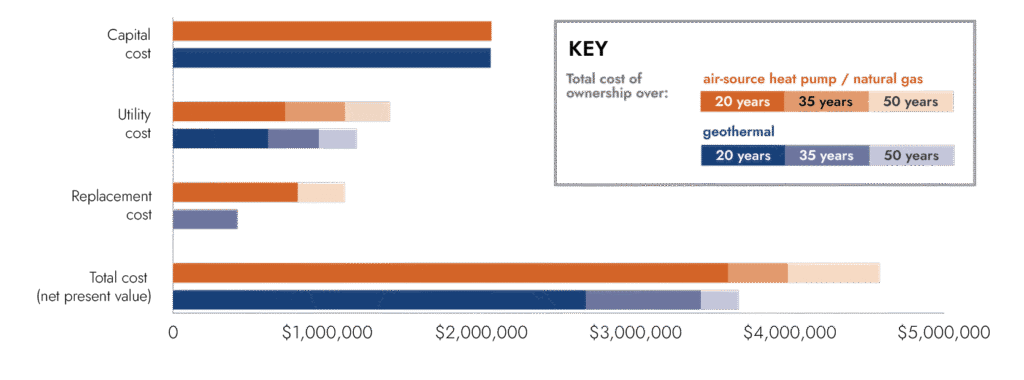
In this model, federal, state, and utility incentives offset geothermal’s higher initial installation costs, resulting in comparable upfront capital investments
The takeaway: The least expensive system to install isn’t necessarily the most economical system to own. Incentives can help lower initial installation costs, and savings can be reflected in the longevity and durability of geothermal systems.
Myth #2: Geothermal Only Works in Certain Regions
The reality: Ground-source heat pumps can operate effectively in climates
across the United States, including the Northeast.
When people hear the word “geothermal,” they often picture hot springs, geysers, or volcanic activity in places like Iceland or the western United States. However, geothermal heating and cooling for buildings work differently from geothermal electricity generation, which typically requires access to much hotter underground resources.
Ground-source heat pumps use the relatively consistent temperature of around 55°F found just a few feet beneath the Earth’s surface. While outdoor temperatures fluctuate dramatically between summer and winter (making air-source heat pumps inefficient on the coldest days), underground temperatures remain much more stable year-round.
During winter, geothermal systems extract heat from the ground and transfer it into buildings. In summer, the process reverses, transferring heat from buildings back into the ground.
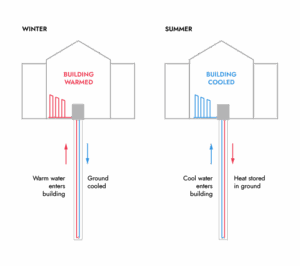
This makes geothermal particularly compelling in regions like New England, where buildings experience both cold winters and warm summers. Rather than relying on fluctuating outdoor air temperatures, ground-source heat pumps exchange heat with a more stable underground environment.
Curious about what a geothermal installation actually looks like? From drilling boreholes to installing underground piping, our Decarbonization for Non-Engineers: Geothermal System Installation video showcases a visual walkthrough of the drilling and installation process, explained without the technical jargon.
The takeaway: Geography alone shouldn’t determine whether geothermal is worth exploring. Building characteristics, underground conditions, and heating and cooling demands matter far more.
Myth #3: You Need a Lot of Open Space to Install Geothermal
The reality: Geothermal systems can be designed for properties with
limited available land, including urban and developed sites.
Another common assumption is that installing geothermal requires a sprawling property with acres of undeveloped land. While available space is an important consideration, modern geothermal drilling techniques allow systems to be installed in much smaller areas than many building owners expect.
Geothermal systems typically use one of two underground configurations: horizontal loops, which require more surface area, or vertical boreholes, which extend deeper underground and occupy a smaller footprint.
For institutions with limited property, vertical boreholes can make geothermal a viable option. In fact, over ⅓ of geothermal projects are installed in urban areas with limited space. Depending on site conditions, drillers may place boreholes beneath lawns, parking lots, or other available outdoor areas.
Of course, smaller sites can present additional engineering and construction challenges. Underground utilities, drilling access, geology, and the building’s heating and cooling requirements all influence feasibility and cost. But limited space doesn’t automatically eliminate geothermal from consideration.
As an example, GreenerU’s plan-design-build team helped to develop a geothermal heating and cooling solution for an established property where available space and existing site conditions had to be carefully considered.
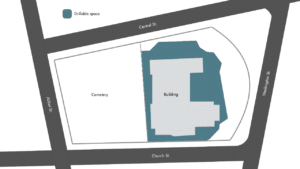
The property’s hilltop setting left little room for drilling. A neighboring cemetery, mature trees, and hardscape constrained where the geothermal wells could go.
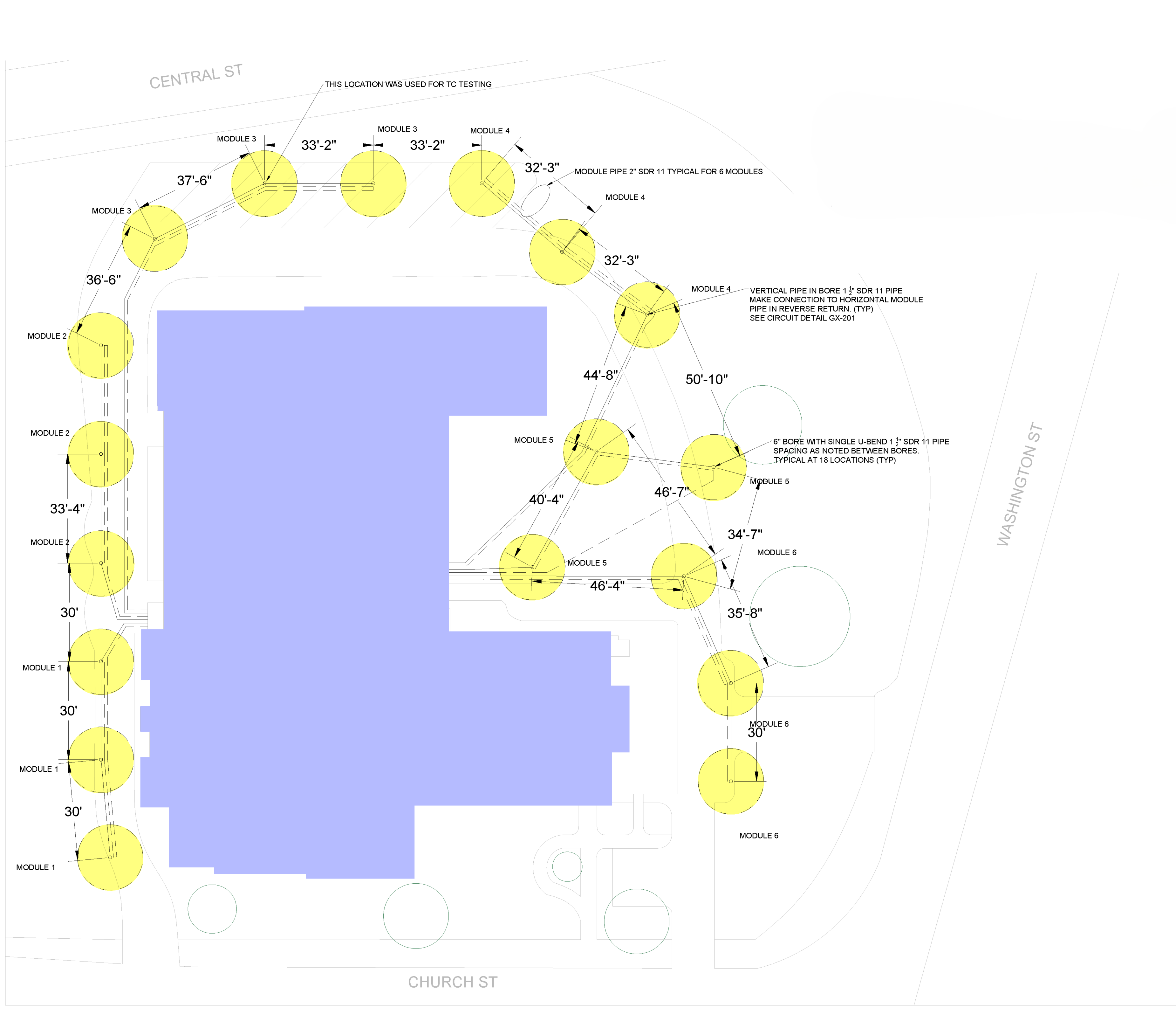
Careful layout and sequencing made space for 18 boreholes.
The takeaway: You may not need as much land as you think. Creative engineering and careful site evaluation can make geothermal possible in locations that initially appear unsuitable.
Myth #4: Installing Geothermal Means Replacing Your Entire Heating System
The reality: Existing building infrastructure can sometimes be reused, reducing construction costs and disruption.
For institutions operating older buildings, replacing an entire heating system can feel intimidating. Many facilities already have extensive piping networks, distribution equipment, and mechanical infrastructure. Removing everything to accommodate geothermal can make the technology seem unnecessarily disruptive and expensive.
Fortunately, a geothermal installation doesn’t always require starting from scratch.
Depending on the existing system’s configuration and operating requirements, geothermal heat pumps can integrate with parts of a building’s existing heating and cooling infrastructure. For example, buildings with hot-water distribution systems may reuse some existing piping. Doing so can reduce the amount of new construction required, potentially lowering project costs and minimizing disruption to occupants.
However, compatibility matters. Traditional boilers often operate at higher water temperatures than geothermal heat pumps can efficiently provide. Engineers must evaluate whether existing piping, terminal units, and controls can support the new system or whether targeted upgrades are necessary.
This is particularly important for institutions that cannot easily suspend daily operations during construction. Colleges, research facilities, and houses of worship need solutions that account for the people who use their buildings every day.
By approaching geothermal through an integrated plan-design-build process, our project teams identify opportunities to reuse existing equipment, coordinate installation around building operations, and avoid unnecessary replacements.
We did this at Wellesley Village church! Check out the full case study here.
The takeaway: Geothermal doesn’t have to mean a complete mechanical overhaul. Knowing what you can reuse is a key part of developing a cost-effective decarbonization strategy.
Myth #5: Federal Tax Credits for Geothermal Have Been Eliminated
The reality: Federal incentives remain available for certain geothermal projects,
although eligibility requirements and deadlines have changed.
Changes to federal energy policy in 2025 have created confusion about which clean energy incentives remain available. As a result, some institutions may assume that the financial benefits previously offered through the Inflation Reduction Act (IRA) have disappeared entirely.
However, qualifying geothermal projects may still be eligible for federal clean electricity investment tax credits under Section 48E. Eligible projects can receive a 30% investment tax credit (ITC). If you install domestically produced equipment (which GreenerU can easily help source), you can receive an additional 10%, bringing the total to 40% of the installation cost, paid back the year after construction. An additional 10% may be available in certain “energy justice communities.”
Importantly, certain tax-exempt organizations, including eligible nonprofits, can benefit from these credits through the IRS’s elective payment mechanism, commonly referred to as Direct Pay. This allows qualifying organizations to receive the value of applicable tax credits even when they do not have federal income tax liability.
An economic comparison developed by GreenerU illustrates how dramatically ITCs can change the equation. In one project analysis, GreenerU compared a geothermal system with an estimated gross cost of about $4.67 million with a natural gas and air-source heat pump alternative costing about $2.14 million. After accounting for modeled utility incentives and federal tax credits, the estimated net capital costs were nearly identical, at approximately $2.06 million each.
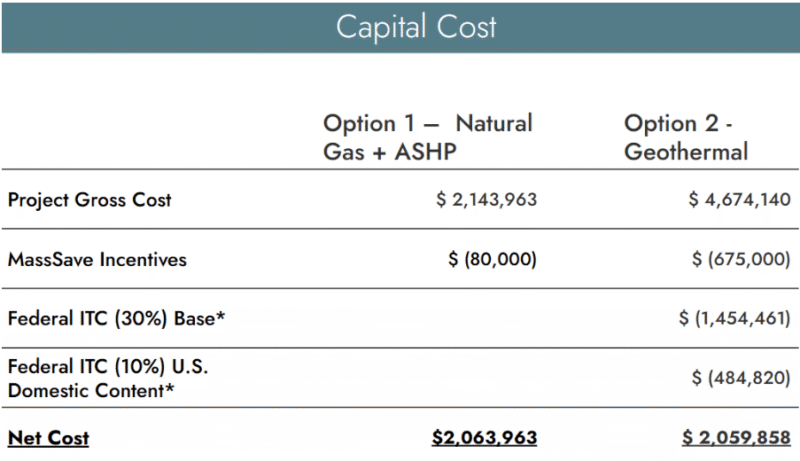
State and utility incentives can also make a dent in upfront capital investment, as seen by the MassSave incentive in this example.
The takeaway: Understanding current federal and state incentive programs can be an important part of determining whether a geothermal project is financially feasible for your building or community.
The Bottom Line: Geothermal Deserves a Closer Look
Geothermal heating and cooling isn’t the right solution for every building, but misconceptions about cost, geography, space requirements, and construction complexity shouldn’t prevent institutions from considering it.
The decision to pursue geothermal should begin with an understanding of the building itself: its existing infrastructure, heating and cooling needs, operational constraints, and long-term financial and decarbonization goals.
At GreenerU, we believe the best building solutions come from evaluating these factors together, not in isolation. Through our integrated plan-design-build model, we help institutions identify practical decarbonization opportunities, develop custom engineering solutions, and carry projects through implementation.
Whether geothermal ultimately proves to be the best option or another technology better serves an institution’s needs, the goal remains the same: making informed decisions that improve building performance, manage costs, and support long-term sustainability.
Interested in exploring whether geothermal could work for your institution? Enter your information below to request a 30-minute meeting with us to chat about your property.